Cumann Seandalaiochta agus Staire Phort Lairge

Friday, April 29, 2022

The Best Seat in the House? Being At Home in the Viking Age by Dr Rebecca Boyd Friday 29th April


The Waterford Archaeological and Historical Society is holding the next lecture in our 2021 – 2022  programme at 8 pm on Friday, April 29th in St Patrick’s Gateway Centre, Waterford (Eircode X91  YX61) when archaeologist Dr Rebecca Boyd will deliver a talk titled ‘The Best Seat in the House?  Being At Home in the Viking Age’. 

Waterford is home to the Vikings, with dozens of Viking-Age houses excavated here. These are very  like houses from Cork and Dublin, but one particular detail stands out. Some houses in Waterford had  a special bench built in beside the hearth in the middle of the home. This hints at the presence of a ‘high  seat’, the most important place to sit in a  Viking house, a symbol of power and status.  Using the idea of a Viking ‘high seat’, we  will tour around the Viking world to see just  how such displays of power and status were  manifested in the Viking home.  

Interior of reconstructed Viking house (Dr. Rebecca Boyd).

Rebecca’s lecture will begin in Iceland with  Njal’s Saga, one of the most famous sagas of  all, where the house itself is a central  character. This house is a Viking longhouse,  and there are many examples of these across  Scandinavia and the North Atlantic. The  power of the family is manifested in the  house, in its size, its architecture, and its  obvious displays of power, connection and wealth. We will look at longhouses with ritual feasting, of  weapon displays, of imported precious glass, to see what story these houses tell. Then, we will return  to Waterford, to reflect on the story and power of our ‘Viking’ houses.


Dr Rebecca Boyd has worked in Irish archaeology for more than 20 years, in commercial, research and academic settings. Rebecca’s own research focuses  on the Viking world and she has written and spoken nationally and  

internationally on the archaeology of Ireland’s Viking Age. Her new book  Exploring Ireland’s Viking Age Towns: Houses and Homes will be  published later this year. It is the first detailed look at urbanism in  Ireland’s Viking Age and is the result of an Irish Research Council  Postdoctoral Fellowship based in the Dept of Archaeology in  

University College Cork. Rebecca currently works as Research  Archaeologist for IAC on the Drumclay Crannog project, one of  Ireland’s most exciting medieval settlements. 


*********************FORTHCOMING LECTURE********************** 

Here are details of the final talk in May: 

27/05/2022 Dr Ann Marie O’Brien ‘A century of change – women and Irish diplomacy’ 

*********************SUMMER OUTINGS**********************

The Society is working on a programme of Summer outings which will include: 16/06/2022 The People’s Park and environs with Joe Falvey 

14/07/2022 Historic Stradbally with Cian Flaherty 

07/08/2022 The Siege of Waterford 1922 with James Doherty 


Sunday, March 20, 2022

Upcoming Lecture 25 March 2022 : Eighteenth-Century Waterford: A Singular City? by Prof. David Dickson


 The next lecture of our 2021-2022 programme will be  on Friday, March 25th at 8:00pm in St Patrick’s Gateway Centre, Waterford (Eircode X91 YX61) when historian Prof. David Dickson will deliver a talk titled ‘Eighteenth-Century Waterford: A Singular City?’.


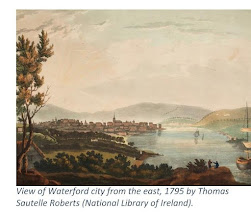
Prof. Dickson’s lecture will begin by reflecting on the emergence of the first cities in eighteenth-century Ireland, distinguishing them from what had come before –  walled towns, very modest by European standards, that had been repeatedly shattered in seventeenth-century warfare. In what respects were these new Irish cities similar to what was happening in Britain and Europe? In the second part of the lecture David will look more closely at 'the quays of the kingdom', Cork, Limerick and Waterford, and the common elements in the rise of the three Munster Atlantic ports; he will also touch on the common elements in the social and economic crisis that beset them in the 1820s. The third segment will focus on how far Waterford was an outlier, a singular city,  in the history of religious conflict and exclusion that was evident in most Irish cities of the period, and it will explore why this may been the case.  The lecture will conclude with a comparison of  the evolution of Waterford and Derry, which were each situated on broad-rivers and graced with their first bridges in the 1790s.  Both cities were very much influenced by the interventions of their Church of Ireland bishops and, more discreetly, by the shadowy influence of the Beresford family.  But was that all?


David Dickson is Emeritus Professor of Modern History in Trinity College Dublin, and was based in the History Department there for most of his career.  He has published very widely on eighteenth-century Irish social and economic history, on regional and urban development, and on the genesis of Irish radicalism. He has also had a lifelong interest in Sub-Saharan African history, and in Ireland's place in European imperial history.  His publications include Old World Colony: Cork and South Munster 1630-1830 (2005), Dublin: The Making of a Capital City (2014), and The First Irish Cities: An Eighteenth-century Transformation (2021).

Tuesday, January 18, 2022

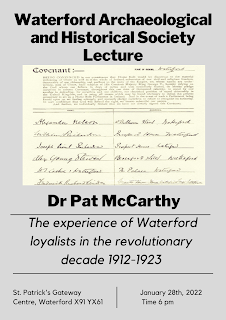
Upcoming Lecture by Dr Pat McCarthy 28 January 2022 :The experience of Waterford loyalists in the revolutionary decade 1912-1923.


The next lecture in our 2021 – 2022 programme at the earlier time of 6 pm on Friday January 28th when historian Dr Pat McCarthy will deliver a talk titled ‘The experience of Waterford loyalists in the revolutionary decade 1912-1923’.


“I had been brought up under the union jack and had no desire to live under any other emblem.” 


The words of C.P. Crane, a Tipperary Resident Magistrate, in 1923, would have found an echo in the hearts of many of Waterford’s loyalist community. By 1926 their population had declined by 40% compared to 1911 and those who survived now lived in a different environment. In 1912 the small but influential loyalist community in Waterford had been vocal in their opposition to Home Rule. Led by Sir William Goff-Davis Goff and Dr Henry Stuart O’Hara, Church of Ireland bishop of the united dioceses of Waterford, Lismore, Cashel and Emly, they had publicly protested against the Home Rule Bill. On October 2 that year Dr O’Hara had led a prayer service in Christchurch which concluded with a signing of the Ulster Covenant by some of his flock – possibly a unique event in Munster. By 1914 they were very much aware that Home Rule for at least three provinces was inevitable and that in the event of a civil war they were extremely vulnerable. Those who attended an anti-Home Rule event had their names noted by a local newspaper which led to sharp exchanges in the House of Commons between the Conservative leader, Andrew Bonar-Law and John Redmond, leader of the Irish Parliamentary Party and MP for Waterford. The outbreak of WW1 changed that, at least temporarily, and they responded enthusiastically to the call to arms. They paid a high price for their loyalty to King and Empire. After the war, they again found themselves vulnerable, especially between the Truce (July 1921) and the end of the Civil War (May 1923), a period in which they were subject to opportunistic violence, a republican campaign of ‘Big House’ burnings and social disorder. In this lecture distinguished historian Pat McCarthy will look at the experiences of Waterford’s loyalist community during the revolutionary decade.


Friday 28th January 2022


6 PM


St Patrick's Gateway Centre

Tuesday, October 12, 2021

Upcoming Lecture 15 October 'A Reflection of Importance’ by Karen Hannon


A lecture by Karen Hannon to the Waterford Archaeological and Historical Society

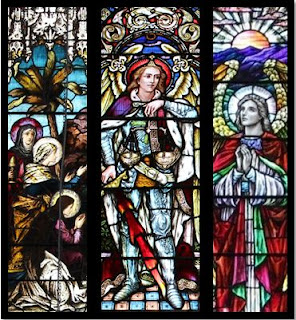
The next lecture in our 2021 – 2022 lecture season on Friday October 15th will be at 8 pm in St Patrick’s Gateway Centre, Waterford when historian and genealogist Karen Hannon will deliver a talk titled ‘A Reflection of Importance’ – A Study of the Memorial Stained Glass Windows of Co. Waterford.

Almost every parish on the island of Ireland, and in the county of Waterford, is home to a memorial stained-glass window.  So often neglected, observed but not truly seen, it would be easy to regard these stained-glass monuments as nothing more than colourful biblical allegories displayed to give inspiration to the devout. But this would oversimplify their role and value as a local history resource. In her talk Karen Hannon will give an overview of the history of stained glass in Ireland and why it was the most highly prized ecclesiastical art form for much of the nineteenth and twentieth century.  She will consider this history through several Waterford case studies examining not only the windows and their designers, but the local families who donated these windows, hoping to shed some light on why these windows were commissioned and by whom?

Other questions that Karen will address include whether stained glass memorial windows were a declaration of importance by families establishing their standing in their parish?  Were they displays of religious commitment by the devout?  Or were they simply an insurance against the finality of death by those wishing to not be forgotten? Karen’s research has shown that the answers to these questions are as varied as the windows themselves, and in the lecture she will reflect on both the craftsmen, the studios and the patrons of these captivating decorative artworks demonstrating both the artistic value of these stained glass windows and their significance for social history.


Karen Hannon is a Waterford historian and genealogist, she has been awarded a BA in History and Diploma in Genealogy by University College Cork.

As usual, the lecture will be at 8 pm in St Patrick’s Gateway Centre, Waterford. Please note that due to current public health restrictions capacity of the lecture venue is limited to 50%, unfortunately WAHS cannot guarantee admittance.

Friday, September 10, 2021

Upcoming Lecture -in St Patrick's Gateway Centre- by Cian Flaherty on 17th September

 Lucky escapes, rising damp or something else entirely? Why so few  County Waterford ‘big houses’ were burned in the Irish Revolution. 

A lecture by Cian Flaherty to the Waterford Archaeological and Historical Society 


After a Covid-enforced suspension of our lecture series in 2020 and 2021 the Waterford Archaeological  and Historical Society are delighted to inform members that our 2021 – 2022 lecture season is  commencing on Friday September 17th next.

Our first lecture will be delivered by historian Cian  Flaherty whose subject is Lucky escapes, rising damp or something else entirely? Why so few  County Waterford ‘big houses’ were burned in the Irish Revolution. 


Members of the IRA, West Waterford Flying Column, at  Cappagh House. Source: Waterford County Museum.


The use of arson in the Irish Revolution has been discussed before. So far, the focus has been on 'big house' burning and the motives behind it. Less attention
has been paid to the reasons why ‘big houses’ were not burned. 
Taking Waterford as a case study, Cian will address the question why the vast majority of Waterford’s ‘big houses’ managed to escape the arsonist’s torch, before discussing the use of arson more broadly in the revolutionary period.


Cian Flaherty is from Stradbally, he graduated from Trinity College Dublin with a  BA (Mod) in History in 2018, and completed an MPhil in Modern Irish History at  Trinity the following year. He has an abiding interest in the history and culture of  mid-Waterford and is currently working on a survey of the old graveyard in  Stradbally.
 
As usual, the lecture will be at 8 pm in St Patrick’s Gateway Centre, Waterford. 


Please note that due to current public health restrictions, capacity of the lecture  venue is limited to 50%, unfortunately WAHS cannot guarantee admittance. 


We have an exciting programme of lectures lined-up for the year ahead. Here are details of the talks  planned for October and November: 

15/10/2021 Karen Hannon ‘A Reflection of Importance - A study of the memorial stained glass  windows of Co. Waterford.’ 

26/11/2021 CĂ³ilĂ­n Ă“ Drisceoil ‘The Dungarvan Valley Caves Project – searching for evidence of  Waterford’s earliest inhabitants’ 


The full programme will be circulated in the coming weeks and will be posted on the Society’s website  and Facebook page. 


The Waterford Archaeological and Historical Society, Ireland.
Website By: Deise Design