Cumann Seandalaiochta agus Staire Phort Lairge

Thursday, July 27, 2023

Outing to Inistioge & Woodstock 30/07/2023

 On Sunday 30 July 2023, at 2.00pm, join us for an outing to picturesque Inistioge, on the banks of the River Nore in south Kilkenny. The town's rich heritage reflects its medieval origins and shows the influence of the Tighe family of Woodstock House in the 18th and 19th centuries. 

Our outing will be led by Ben Murtagh, expert on Inistioge's archaeology and medieval history, and John Kirwan, who has extensively researched the role the Tighe family played in the later development of the town.


Wednesday, July 19, 2023

Outing to Creaden Head 23 July 2023


 For many years the late Noel McDonagh explored the archaeology of Creadan head, the striking peninsula at the mouth of Waterford Harbour. In recent years the Portalis Project, based in SETU, brought together a multidisciplinary team to build on this work researching the archaeology, geology and social history of the headland. On our outing next Sunday afternoon we have an opportunity to meet members of the team and hear about the research that they have been carrying out.


As parking is limited on the headland, and out of consideration for local residents, the Portalis Project have kindly organised a mini-bus to transfer members from the carpark at Holy Cross Church, Killea, Dunmore East to Creadan Head at 1:30 pm. 

Tuesday, July 11, 2023

Outing to Newtown School, 13 July 2023


 This year marks the 225th anniversary of Newtown School.

Please Join us for a historical stroll around the School and Grounds with Joe Falvey, historian and former teacher. 

Meet at Newtown School (X91 XR20) at 7pm, Thursday, July 13th .

Thursday, June 8, 2023

Upcoming Outing : Tramore, with Paul Brent on 11th June 2023

Our first Summer Outing will take place in Tramore on Sunday 11th June 2023.

Meet near The Coast Guard Cultural Centre (Eircode X91 HP63) at 2pm

Our guide Paul Brent will tell members and guests the history of the following as we walk.


  • The Doneraile family and the Walk named after them
  • The Tramore Coastguard building
  • The Wrecks of Tramore Bay
  • The Metal Man
  • The Harbour in Lady Elizabeth's Cove
  • Lady Doneraile's Cove
  • The Officer's tombstone on the Doneraile walk
  • The Coastguard Gun Battery
  • Abraham Denny Architect and his home
  • The Coastguard Iron Armstrong Coastal Defence Gun on the Doneraile

We will visit Christ Church to view the Sea Horse Monument before walking back by Albion House and Tramore Tennis Club.

Members free, non-members €5.00


Tuesday, May 16, 2023

Upcoming Lecture on 26 May 2023 : Jewish Footprints in Provincial Ireland and the Minority Experience by Trisha Oakley Kessler


The Waterford Archaeological and Historical Society 2022 – 2023 lecture series concludes at 8 pm on Friday, May 26th in St Patrick’s Gateway Centre, Waterford (Eircode X91 YX61) when Dr Trisha Oakley Kessler, research associate, Woolf Institute, Cambridge, will deliver a talk titled ‘Jewish Footprints in Provincial Ireland and the Minority Experience’.


 Harry Goodman ran a photographic studio in Waterford from 1900, branching out to open other studios in Tramore and Carrick-on-Suir over the following decade. This undated photograph of a shopkeeper in Waterford could well be that of Isaac Levi in his shop on John Street. Levi’s wife, Florie Goldring, was, according to the 1901 Irish census, also a photographer and most likely working with Goodman. She may have taken this photograph. Seemingly, Goodman was successful in his profession, photographing Irish men, women and children. By doing so, he created a visual recording of provincial Irish lives that hopefully have been passed down the generations. Yet, ironically, the only visible artefacts of Goodman’s life in Waterford are his embossed signature on this photograph and several announcements in the local paper regarding his studios. This raises the question of why there are so few traces of  Jewish lives outside the larger communities in Dublin, Belfast, Cork and Limerick.

Dr Trisha Oakley Kessler’s talk will map the presence of Jews in provincial Ireland in the early decades of the twentieth century to explore how they negotiated belonging and identity during a period in which the Irish people were also navigating political, economic and social change. Exploring the Jewish minority experience highlights concepts of agency, visibility and invisibility. In addition, it examines minority strategies as Jews engaged in new encounters to find a sense of place in Ireland.

Dr Trisha Oakley Kessler explores the Irish economy through a socio-cultural lens to understand everyday life, racism, nationalism and gender in Irish history. Her doctoral thesis from University College Dublin explored political and economic change in 1930s Ireland through the prism of three factories established in provincial Ireland by Jewish refugees, which helped to build a new ladies' hat industry. How these factories came into existence, the economic networks that enabled them to arrive, the challenges they faced entering the Irish economy and their political and economic impact offer a prism to explore identity, modernity, belonging and industrial change. She is interested in the workings and the shifting meanings of factories in twentieth-century Irish provincial life.

Her research interests also focus on the Irish-Jewish community and Irish-Jewish encounters in Ireland and the diaspora. Working with ‘ego documents’, autobiographical writing including memoirs, private correspondence and oral histories, she is working on a social-cultural history of Jews in the Irish economy.

Trisha has taught on a Special Subject Paper, 'An alternative history of Ireland: religious minorities and identity in the 26 counties, 1900-1959' at the Faculty of History, University of Cambridge, where she also supervises undergraduates on modern Irish history. In addition, Trisha is a Co-Convenor of the Cambridge Modern Irish History Seminar. She is a Research Associate at the Woolf Institute Cambridge and a Non-Stipendiary Teaching Research Fellow at the Herzog Centre, Trinity College Dublin.

Thursday, April 20, 2023

Upcoming Lecture by Dr Meriel McClatchie: Food and Farming in Co Waterford, Evidence from Archaeological Excavations

The Waterford Archaeological and Historical Society 2022 – 2023 lecture series continues at 8 pm on Friday, April 28th in St Patrick’s Gateway Centre, Waterford (Eircode X91 YX61) when Dr Meriel McClatchie, Associate Professor, School of Archaeology, UCD, will deliver a talk titled ‘Food and Farming in Co. Waterford: Evidence from Archaeological Investigations’.


In this lecture Dr McClatchie will examine food and farming in Co. Waterford over the past 10,000 years, based upon evidence from archaeological excavations. Food remains are often recovered during archaeological excavations, most often in the form of animal bones and plant components such as seeds. The study of this material is known as zooarchaeology and archaeobotany, respectively. The lecture will focus more on archaeobotany, which is Meriel’s main area of research, but zooarchaeology will also be included.
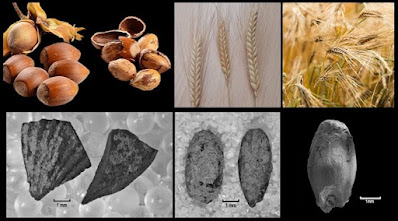

 Charred plant remains are used by archaeologists to reconstruct past diets and farming practices. Neolithic hazelnut shell (left), Neolithic emmer wheat grains (middle), Bronze Age barley grain (right).) 


Archaeobotany is the study of past societies and environments through the analysis of preserved plant remains. These tiny, fragile remains require special conditions to enable their preservation over centuries and millennia. Most often they are preserved because they have been burnt, perhaps when being dried or cooked over a fire, or when dumped into a fire as waste. Plant remains can also become preserved when kept consistently wet (waterlogged), which has been encountered in urban deposits from Viking and medieval Waterford. Although animal bones are more durable than plant remains, they also require certain conditions for preservation. Unfortunately, the acidic soils in some parts of Ireland mean that animal bone does not survive well at all sites, but where they are preserved, they can provide important insights into food choices and animal management practices.


Meriel’s talk will take several points in time over the past 10,000 years to explore the character of food and farming in Co. Waterford, and how it changed over the years. The earliest archaeological evidence for settlements in Ireland dates to the Mesolithic period, which began around 10,000 years ago. Over the following four millennia, hunter-gatherers made use of many different environments to gather plants above and below ground, hunt (including wild pig) and fish for food. Farming arrived in Ireland almost 6000 years ago, in the first centuries of the Neolithic period. New domesticated crops and animals were brought to Ireland, including emmer wheat and barley, as well as cattle and sheep/goat. During the Bronze Age, which began over 4000 years ago, and the Iron Age, which began over 2500 years ago, new farming management practices emerged, as well as new crops, such spelt wheat. Following the arrival of Christianity during the early medieval period more than 1500 years ago, farming was transformed, both in terms of how it was practised and what was farmed; new crops included oat and legumes. In some areas, there was a shift towards bread wheat from around 800 years ago (the medieval period), and many records of foods being exported from and imported into Ireland; the latter included ‘exotic’ foods such as figs, almonds and walnuts. Finally, during the post-medieval period (from almost 500 years ago), further changes in food choices can be detected, often reflecting changing social and religious practices. This lecture will draw upon case studies from each period over the past 10,000 years to explore changing food practices and what these can reveal about broader society.


Meriel McClatchie is an Associate Professor of Archaeology at University College Dublin. She began her studies at University College Cork, where she completed BA and MA degrees in 1995 and 1997, respectively. She later undertook PhD research at University College London (degree awarded 2009). Since her undergraduate studies, Meriel’s main research interest has been what is known as ‘archaeobotany’: the scientific analysis of ancient non-wood plant macro-remains, such as cereal grains and chaff, seeds of other crops, weed seeds, fruit stones and nutshell. Archaeobotany was the basis of both her Masters dissertation at UCC (which explored medieval engagements with plants) and PhD thesis at UCL (which explored food and farming in Bronze Age Ireland). Her current research is focused on archaeology in Europe, with a particular interest in food (from early prehistoric to early modern societies), prehistoric landscapes and settlements. In recent years, she has undertaken fieldwork in Serbia and Tanzania, and she also undertook fieldwork in Uganda during her PhD studies.


Meriel is Director of the Ancient Foods Research Group and the Archaeobotany Laboratory at UCD. Her current major research projects are investigating

•     early modern foodways (Foodcult; www.foodcult.eu)

•     underutilised crops (Croprevive; https://www.ucd.ie/archaeology/research/croprevive/) and

•     food storage and security (Foodsec; https://www.ucd.ie/archaeology/research/foodsec/).


All welcome, non-members €5.

WAHS Committee 2023 - 2024

 Following the AGM of  31 March 2023, the following committee was elected: 

Officers:

Chairperson : Joe Falvey
Vice Chair :  Erica Fay
Honorary Secretary :  Simon Dowling
Honorary Treasurer : Donnchadh Ó'Ceallacháin
PRO :  James Eogan
Honorary Editor : David Prendergast
Representative to the Federation of Local History Societies :  Clare Walsh


Committee Members : 

   Anne Cusack
Mary Breen
 Sonny Condon
Greta Falvey
 Michael Farrell
 Ben Murtach
Béatrice Payet
 Bill Walsh

Ex Officio :

Nóra Tubbritt


The Waterford Archaeological and Historical Society, Ireland.
Website By: Deise Design