Cumann Seandalaiochta agus Staire Phort Lairge

Thursday, February 27, 2020

Upcoming Lecture 28 February : Inspired language – cursing, swearing and blessing in early modern Waterford and Kilkenny.

Inspired language – cursing, swearing and blessing in early modern Waterford and Kilkenny.

A lecture by Dr Clodagh Tait

Time: 8 pm 

Venue : St Patrick’s Gateway Centre, Waterford 

Irish cursing traditions are often treated in a lighthearted way. 
One nineteenth-century observer commented that ‘Irish curses are always picturesque’. 
But close examination of accounts of the ritual curse and of other acts of ill-wishing, reveals 
deep fears about their power, danger and potential to cause real harm. Traditions of cursing in
 the Waterford and Kilkenny area are recorded as far back as the medieval period, and 
continue to the present day. In her lecture Dr Tait will give an overview of Irish cursing traditions,
 and will focus in particular on the seventeenth century. 
Strong belief in the power of the parental blessing and the parental curse can be found in the 
surviving wills and letters of this period. Looking at the language of cursing and blessing as used
 in family documents tells us much about understandings about the relationship between parents and 
children in this period, about the cultural resources used by fathers to attempt to guide or control their 
children and wives, and about ideas about love and duty in early modern families.

Clodagh Tait lectures in History at Mary Immaculate College, having previously worked in the 
University of Essex and UCD. She is the author of Death, Burial and Commemoration in Ireland,
 1550-1650, and co-editor of Age of Atrocity, and Religion and Politics in Urban Ireland, and has
 published articles on a variety of early modern topics including women, maternity, infant care, 
death, commemoration, martyrdom, belief and crowd violence. She wrote the chapter on 'Society
 1550-1700' in the second volume of the Cambridge History of Ireland. 
Her current projects include a history of Irish cursing and ill-wishing between 1550 and 1950 and 
a study of the supernatural labours of Irish mothers in the nineteenth and early twentieth centuries.




Friday, January 24, 2020

Upcoming Lecture : Crisis and Long Term Effects of the Influenza Pandemic in Waterford and Ireland by Dr Ida Milne


The Waterford Archaeological and Historical Society 2019 – 2020 lecture season continues on Friday January 31st January 2020 with a lecture at 8 pm in St Patrick’s Gateway Centre, Waterford when Dr Ida Milne will deliver a talk titled “Crisis and long term effects – the 1918 – 1919 influenza pandemic in Waterford and Ireland”.

Dr Milne will take a global, national and regional perspective to examine the 1918-1919 pandemic and its political and social history, and look briefly at the figures.  South-east Ireland was quite the hot spot for flu in the second wave in October through December 1918, and to a lesser extent in the spring of 1919.

What this talk will focus on are the oral histories of the flu that Dr Milne collected during her research. Some oral histories were collected from survivors who caught it as small children and often didn’t realise until she spoke to them that what they had been through was this amazing disease that killed upwards of 50 million globally. When Ida started collecting oral histories about the flu she thought that she would find out about the illness, the treatments given to patients, doctors visiting, and other immediate experiences. What she found was much more fascinating, the flu had wider ramifications than just illness and death. Often if a parent died, it changed the entire economic status of families, they might also lose their home if it went with the parent’s job, or the single remaining parent might decide to emigrate. So the fallout was a lot more that it seemed, and often caused long term emotional crises too.


Dr Ida Milne is a lecturer in European history at Carlow College.  She is a social historian who specialises in using oral history to explore her research interests which include Irish Protestant identity, working lives and broad interests in the history of infectious disease. ‘Stacking the Coffins, Influenza War and Revolution in Ireland’, the book based on her doctoral research on the 1918 flu pandemic, was published in 2018. She is co-editor with Dr Ian d’Alton of the recently published book ‘Protestant and Irish – The Minority’s Search for Place in Independent Ireland’. A native of Wexford, Ida attended Waterford’s Newtown School in the 1970s.

Monday, November 25, 2019

A Sense of Community

Going through the daily grind we never think of the impact we might have on others.
It is very rare to have someone giving you feedback and saying 'Hey, you've inspired me'
or
'I got curious and wanted to know more after I heard / saw...'

We've been using St Patrick's Gateway Centre now for a while...

We've seen it being transformed over the months, we attended lectures on its history, on the lives
of people past. What about today's people?

Have we stopped to notice the changes or just rushed in and out of the doors?

The entrance hall has been decorated, volunteers working in the background have contributed in their own way.

Tables are moved, chairs set up, decorations hanged, refreshment served, and so many other things we are not aware of.

Sometimes we get a chance to chat to the volunteers that help set things up for our lectures.

Has anyone noticed a new frame on the right hand-side, as you go in the main hall?

Jay has taken time to find out about the history of the church, and discovered so much,  he put in his own words the importance of the church for communities throughout the centuries.

The last lines of his composition sum  up so well what the centre is about. (Click on picture to enlarge)


Friday, November 22, 2019

November Lecture: Red Hand on the Suir by Francis Devine


Our next lecture will be

Red hand on the Suir – 
the Irish Transport and General Workers Union 
in Waterford in the early 20th century

 by Francis Devine, retired ITGWU/SIPTU official, historian, writer, singer.

Date: Friday 29th November 2019 

Venue: St. Patricks Gateway Centre, Patrick Street, Waterford.

Time: 8pm.

Admission 5 Euro,   members no charge


Waterford was a founding branch of the Irish Transport & General Workers' Union in 1909 but its early years were turbulent.
Re-established after 1918, the ITGWU presence was badly affected by the historic Farm Labourers' Dispute of 1923 – a dispute with national consequences and central to the Free State's attack on labour. 
Defeat for the ITGWU arguably had repercussions for the union in West Waterford which have lasted until the present day. In 1923, the ITGWU spent a huge amount – over £40,000 – in Strike Pay within county Waterford in an attempt to prevent wage cuts for their farm labourer members. 
However, by 1930, membership had fallen from over 4,700 in 1923 to a mere 300 with many branches wiped out. 
Thomas Dunne was the Waterford ITGWU Branch Secretary throughout the period, a lengthy tenure that did not conclude until the 1940s. The ITGWU's declining fortunes reflected those of organised labour nationally but the union survived and was to revive after 1945 to again become a significant force within the city.


Francis Devine is a retired ITGWU/SIPTU official, a historian, an author and an editor. He wrote Organising History: A Centenary of SIPTU, 1909-2009 (Gill & Macmillan, Dublin, 2009) and has also written histories of the Medical Laboratory Scientists' Association and the Communications Workers' Union. He co-edited two volumes of Left Lives in Twentieth Century Ireland with Jack McGinley, and a collection of essays on William Walker's Centenary with Patrick Smylie. He is a former editor of Saothar, the Journal of the Irish Labour History Society. 
He is a member of the Expert Advisory Group on Commemorations which was established by the Taoiseach in 2011 to advise the Government on historical matters relating to the Decade of Centenaries. Francis is an accomplished singer, he released the CD My Father Told Me in 2014, and has a second CD An Ownerless Corner of Earth due for release in February 2020.


Wednesday, November 13, 2019

Waterford City: A History - Book Launch 15th November


The launch of Waterford City: A History by Cian Manning published by The History Press will take place at The Book Centre on Friday 15th November at 6:30pm.

It will be launched by Donnchadh Ó Ceallacháin of Waterford Treasures and accompanied by music from Bogdan Chaus & Ailíse O'Neill of Deep Foxy Glow.

Wine and some light refreshments will be available

Waterford, Ireland’s oldest city, established by the Vikings, has been witness to many significant historical events.
From the marriage of Strongbow & Aoife, it became a vibrant location of religious devotion which earned it the nickname Parva Roma – Little Rome -  to the splendour of the Georgian period, Waterford City documents those momentous events but also the lesser known stories such as the first frog to be recorded in Ireland to the invention of the cream cracker.
This study looks at the social and economic history of the city from Vikings to Victorians covering its notable characters who impacted the local, national and sometimes international scene
 

Thursday, October 31, 2019

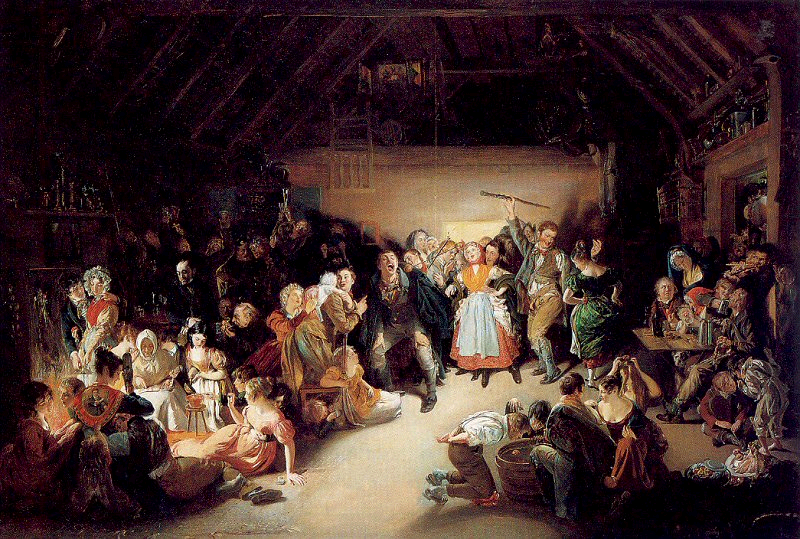
Snap Apple Night

In Waterford the most famous painting by Daniel Maclise remains the Wedding of Stongbow and Aoife.

The artist also painted a scene inspired by a Halloween party in Blarney, co. Cork, in 1832.


Tuesday, October 22, 2019

A Mix of Music and History for the launch of Decies 75


It was certainly fitting to have the launch of the journal linked to a weekend of musical celebration, (John Dwyer Trad Weekend) since one of the articles concerns the 75th anniversary of the founding of Waterford Music Club, as illustrated on the cover with the photograph of the medallion of the club.


The launch kicked off with
Dr Jimmy O'Brien-Moran 
who played a few tunes on the Uilleann Pipes, 
before rushing off to another venue. 


Some of the contributors to the journal had also been invited to give a short talk related to the article they wrote.


Cian Flaherty talking about the diary of Bishop Stock, written in 1811. 


A great number was in attendance despite the heavy downpours outside.


Continuing the musical theme, Jenny Walsh played a few tunes on the fiddle

There had been great excitement in Dungarvan when excavations on a hill outside the town
 revealed multiple burials had taken place many centuries ago. 
The Gallows Hill Community Archaeology Project took place between 2015 and 2019.

Dave Pollock, archaeologist, stepping in for Christina Knight-O'Connor, gave us an insight on the work done on Gallows Hill. 

The launch was brought to a close with some more music, bringing us nicely back to the modern times


Committee member and former chaiman Sonny Condon on the harmonica 
had us humming along to The Rose.


Peigí Devlin, Hon editor, and her editorial committee:
Clíona Purcell, Shane Brown and Cian Flaherty.


Dr Elizabeth Twohig, Chair of the Waterford Music Club, 
wearing the medallion that appears on the cover of this year's journal. 
The Waterford Archaeological and Historical Society, Ireland.
Website By: Deise Design